
From Wiki:
Plot
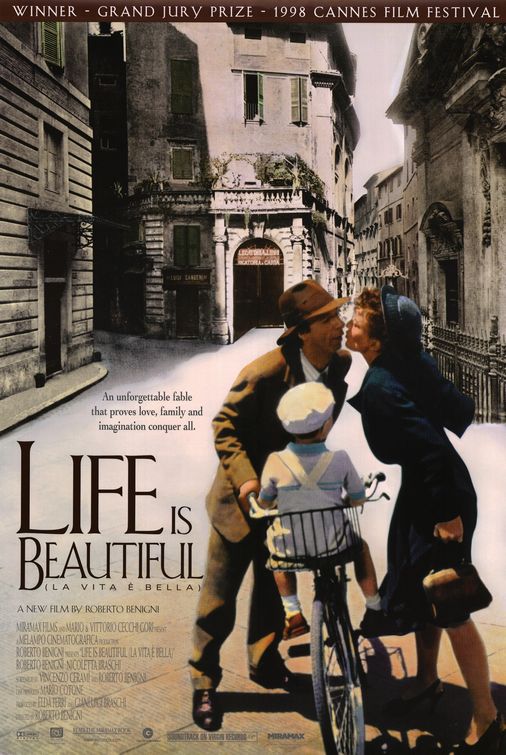
The first half of the movie is a whimsical, romantic, somewhat slapstick comedy set in the early years of World War II.
Guido is both funny and charismatic, especially when he romances a local school teacher, Dora (portrayed by Benigni’s actual wife Nicoletta Braschi), saying she is beautiful like the morning sunrise. Dora, however, comes from a wealthy, aristocratic, non-Jewish Italian family. Dora’s mother wants her to marry a well-to-do civil servant, but Dora falls instead for Guido, who ends up stealing her away at her engagement party from her aristocratic and arrogant fiancé.
Several years pass in which Guido and Dora marry and have a son, Giosuè (Giorgio Cantarini).
Dora and her mother (Marisa Paredes) are estranged due to the unequal marriage. Later on, a reconciliation takes place just prior to Giosuè’s fourth birthday.
In the second half of the film, World War II has already begun. Guido, Uncle Eliseo and Giosuè are forced onto a train and taken to a concentration camp on Giosuè’s birthday. Despite being a non-Jew, Dora demands to be on the same train to join her family and is permitted to do so.
In the camp, Guido hides his son from the Nazi guards, sneaks him food and tries to humor him. In an attempt to keep up Giosuè’s spirits, Guido convinces him that the camp is just a game, in which the first person to get 1,000 points wins a tank. He tells him that if he cries, complains that he wants his mother, or says that he is hungry, he will lose points, while quiet boys who hide from the camp guards earn points.
Guido convinces Giosuè that the camp guards are mean because they want the tank for themselves and that all the other children are hiding in order to win the game. He puts off Giosuè’s requests to end the game and return home by convincing him that they are in the lead for the tank. Despite being surrounded by rampant misery, sickness and death, Giosuè does not question this fiction because of his father’s convincing performance and his own innocence.
Guido maintains this story right until the end when, in the chaos caused by the American advance, he tells his son to stay in a sweatbox until everybody has left, this being the final test before the tank is his. Guido goes off to look for Dora but is caught and shot to death off camera, by a Nazi soldier.
Giosuè manages to survive, reunite with his mother, and even thinks he has won the game when an American tank arrives to liberate the camp. In the film, Giosuè is four and a half years old; however, both the beginning and ending of the film are narrated by an older Giosuè recalling his father’s story of sacrifice for his family.
| Directed by | Roberto Benigni |
|---|---|
| Produced by | Gianluigi Braschi Elda Ferri |
| Written by | Roberto Benigni Vincenzo Cerami |
| Starring | Roberto Benigni Nicoletta Braschi Giorgio Cantarini Giustino Durano Sergio Bini Bustric |
| Music by | Nicola Piovani |
| Cinematography | Tonino Delli Colli |
| Editing by | Simona Paggi |
| Studio | Cecchi Gori Group |
| Distributed by | Miramax Films |
| Release date(s) |
|
| Running time | 116 minutes |
| Country | Italy |
| Language | Italian |
 Moviola